OpenClaw vs AutoGPT: Which AI Agent Actually Works?
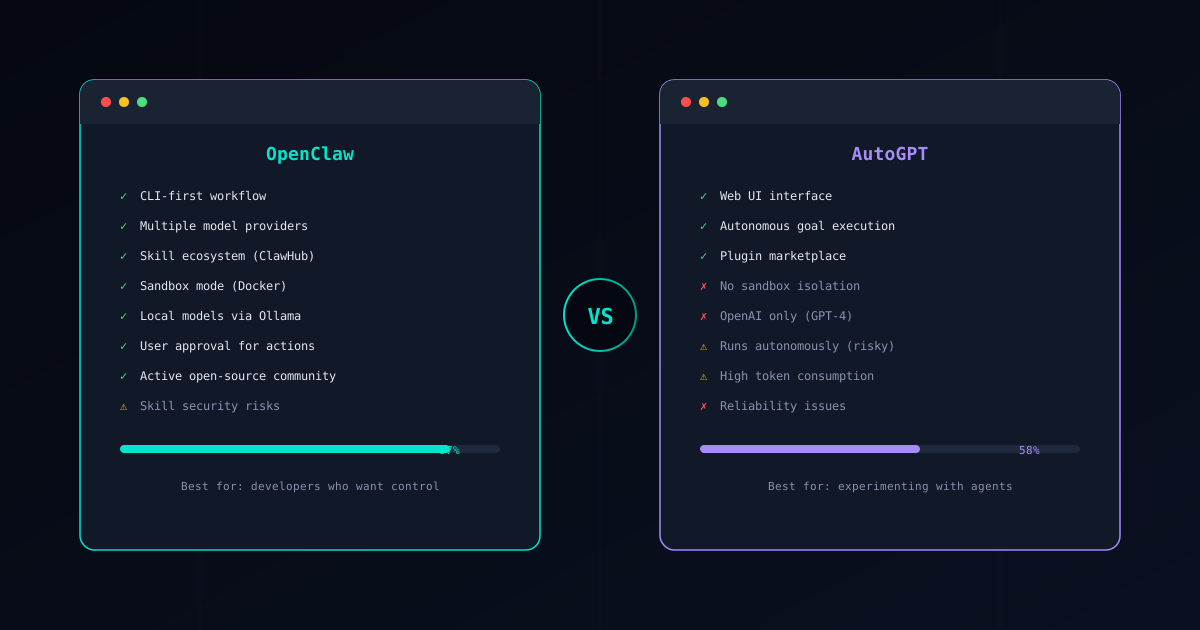
OpenClaw and AutoGPT are both AI agent frameworks, but they come from fundamentally different places. OpenClaw was built to be a practical assistant that helps developers get real work done. AutoGPT was built to explore what happens when you let an AI plan and execute tasks with minimal human intervention.
That difference in philosophy shapes everything: reliability, cost, security, and whether you actually accomplish what you set out to do. This guide breaks down the comparison honestly so you can pick the right tool for your situation.
If you are new to OpenClaw, start with our What is OpenClaw? overview first.
Core Philosophy
OpenClaw: “What does the user need done?”
OpenClaw starts from a concrete problem. You give it a task, it uses skills and tools to accomplish that task, and it asks for confirmation before making changes. The agent stays focused on your goal and uses structured skills that have been tested and verified.
The workflow is straightforward: you describe what you need, OpenClaw proposes a plan, you approve or adjust, and the agent executes. Every step is visible and reversible.
AutoGPT: “What could AI figure out next?”
AutoGPT starts from a goal and then recursively plans sub-goals, creates tasks, executes them, evaluates results, and plans again. The idea is that the AI should be able to break down any objective into steps and work through them autonomously.
In theory, this sounds powerful. In practice, it means the agent frequently loses track of the original goal, spends tokens on tangential planning, and produces unpredictable results. The autonomous loop was a fascinating experiment in 2023, but real-world usage has exposed its limitations.
Feature Comparison
Here is how the two frameworks compare across the dimensions that matter for daily use:
| Feature | OpenClaw | AutoGPT |
|---|---|---|
| Setup Time | ~30 min | Hours |
| Reliability 24/7 | Stable daemon | Prone to loops |
| Integrations | 50+ skills | Limited plugins |
| Autonomy Level | Semi-autonomous | Fully autonomous |
| Cost per task | $0.10-2.00 | $5-50+ |
| Security Model | Sandboxed skills | No sandboxing |
| Community | Active GitHub | Declining |
The cost difference is not a minor detail. AutoGPT’s recursive planning means a single task can consume hundreds of thousands of tokens before producing a result — or before getting stuck in a loop and producing nothing at all. OpenClaw’s skill-based approach keeps token usage predictable because each skill knows exactly what it needs to do.
AutoGPT’s Fundamental Problems
AutoGPT deserves credit for sparking the autonomous AI agent movement. But after two years of real-world usage, three core problems have become clear.
Endless Planning Loops
AutoGPT’s recursive goal decomposition frequently enters cycles where the agent plans to plan, evaluates its plan, decides the plan needs revision, and replans. This can continue indefinitely without producing any actual output.
The root cause is that the agent lacks a clear stopping condition. It optimizes for “have I considered everything?” rather than “have I done what the user asked?” When the search space is open-ended — which it usually is — the planning loop has no natural termination point.
OpenClaw avoids this by design. Skills have defined inputs, outputs, and execution boundaries. The agent executes a skill, returns the result, and waits for your next instruction. There is no recursive self-evaluation loop because the human is the evaluator.
Token Waste
Every iteration of AutoGPT’s planning loop consumes tokens. The agent re-reads its own previous outputs, re-evaluates the goal tree, and generates new plans — all before doing any actual work. A task that would take OpenClaw $0.50 in API calls can easily cost $20-50 with AutoGPT.
This is not just an optimization issue; it is architectural. The autonomous loop requires the agent to maintain a running narrative of everything it has done and thought, which grows with every iteration. By the time AutoGPT actually starts executing, it may have already spent most of its token budget on planning.
OpenClaw’s approach is fundamentally different. Each skill call is a discrete, bounded operation. The agent does not need to maintain a growing internal monologue because the conversation history serves that purpose, and you control what stays relevant.
Memory Limitations
AutoGPT relies on vector databases and summary chains to maintain context across its planning loops. In practice, this memory system is lossy. The agent frequently forgets constraints it identified earlier, re-discovers problems it already solved, or contradicts its own previous decisions.
Long-running AutoGPT sessions degrade as context accumulates. The agent’s effective memory is limited by the model’s context window, and the summarization process discards nuance that turns out to be important later.
OpenClaw sidesteps this problem by keeping sessions focused. Rather than one long autonomous run, you work in short, directed interactions. The project context (your files, your codebase, your configuration) is the persistent memory, not a summary chain that drifts over time.
When AutoGPT Might Make Sense
Despite these issues, there are scenarios where AutoGPT’s approach has value:
- Research exploration — When you genuinely want the AI to explore a topic without a specific deliverable in mind, the autonomous loop can surface unexpected connections.
- Brainstorming without constraints — If you want to see how an AI breaks down a vague goal, AutoGPT’s planning output can be interesting as a thinking tool (even if you would never let it execute).
- Academic experiments — Studying autonomous agent behavior, failure modes, and emergent planning patterns is a legitimate research use case.
- Prototyping agent architectures — If you are building your own AI agent system, running AutoGPT helps you understand what works and what does not in recursive planning.
The common thread: AutoGPT is useful when the process is the point, not the output. If you need a reliable result by a deadline, it is not the right choice.
Other Alternatives
AutoGPT is not the only alternative to OpenClaw. Several other frameworks and tools exist in the AI coding agent space:
BabyAGI was one of the earliest task-driven autonomous agents. It uses a simpler loop than AutoGPT but shares the same core problem: recursive planning without clear termination. Development has slowed significantly.
SuperAGI attempted to add a management layer on top of autonomous agents, with dashboards and resource controls. It addresses some of AutoGPT’s cost issues but inherits the reliability problems of autonomous execution.
CrewAI takes a multi-agent approach where specialized agents collaborate on tasks. The framework is more structured than AutoGPT, but the autonomous nature of each agent means the same loop and memory issues apply at scale.
LangChain agents provide lower-level building blocks for creating AI agent pipelines. LangChain is more of a toolkit than a product — it gives you flexibility but requires significant development effort to build anything production-ready.
For comparisons with other categories of AI coding tools, see our guides on OpenClaw vs Cursor, OpenClaw vs GitHub Copilot, OpenClaw vs Claude Code, OpenClaw vs Devin, OpenClaw vs Aider, and OpenClaw vs Windsurf. For a full overview, see the Best AI Coding Agents 2026 roundup or OpenClaw Alternatives.
Security Comparison
Security is where the difference between these approaches becomes critical.
OpenClaw’s Security Model
OpenClaw provides multiple layers of protection:
- Skill verification — Every skill in the Verified Skills catalog has been audited for malicious behavior. The Skill Verifier lets you check any skill before installation.
- Sandbox mode — Skills execute inside Docker-based isolation that prevents filesystem access, network exfiltration, and system-level commands. See the Sandbox Setup Guide for configuration details.
- Permission model — Each skill declares what it needs (file access, shell commands, network requests), and the user approves or denies those permissions explicitly.
- Human approval gates — The agent proposes changes and waits for confirmation before executing. No surprise modifications to your codebase.
For a deep dive into securing your setup, read our OpenClaw Security Guide.
AutoGPT’s Security Model
AutoGPT runs with whatever system access the process has. There is no built-in sandboxing, no skill verification system, and no permission model. The agent can:
- Read and write any file the process owner can access
- Execute arbitrary shell commands
- Make network requests to any endpoint
- Access environment variables, including API keys and credentials
Some users run AutoGPT inside Docker containers for isolation, but this is a manual setup with no standardized approach. The agent itself has no awareness of security boundaries.
This is not a criticism of the AutoGPT team — autonomous execution and fine-grained security controls are inherently in tension. If an agent needs to figure out what to do next on its own, restricting its capabilities defeats the purpose. OpenClaw resolves this tension by keeping the human in the loop.
Conclusion
The choice between OpenClaw and AutoGPT comes down to what you need:
Choose OpenClaw when you need:
- Reliable task completion for real projects
- Predictable costs and token usage
- Security controls that protect your codebase and credentials
- An active community with maintained skills and regular updates
- A tool that integrates into your existing development workflow
Choose AutoGPT when you want:
- To experiment with autonomous AI behavior
- To study how recursive planning works and fails
- A research platform for agent architectures
- To explore a topic without a specific deliverable
For the vast majority of developers and teams, OpenClaw is the practical choice. It does the work, stays within budget, and does not put your system at risk.
Ready to get started? Follow the Installation Guide to set up OpenClaw in about 30 minutes. If security is your top concern, begin with the Sandbox Setup Guide and the OpenClaw Security Guide to harden your environment from day one.