OpenClaw vs CrewAI: Single Agent Control vs Multi-Agent Orchestration
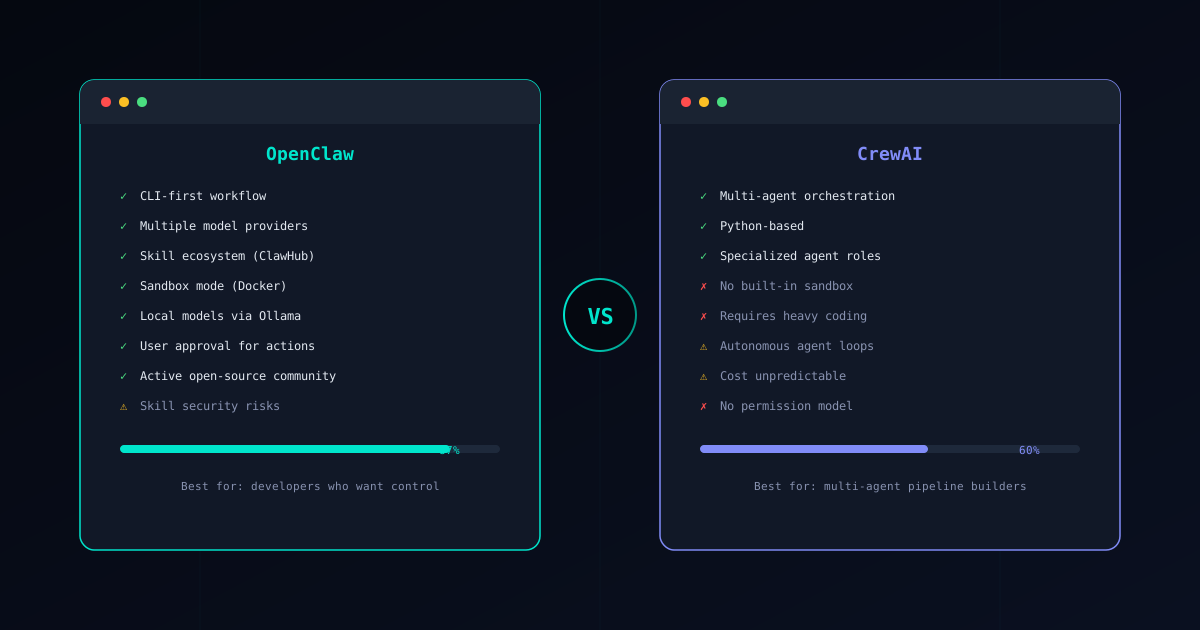
OpenClaw and CrewAI approach AI agent work from opposite directions. OpenClaw gives you a single, focused agent that you control step by step. CrewAI gives you a framework for building teams of autonomous agents that collaborate with each other.
That distinction matters more than it sounds. A single controlled agent and a multi-agent orchestration system have different failure modes, different cost profiles, and different security implications. This guide walks through the comparison honestly so you can decide which fits your workflow.
If you are new to OpenClaw, start with our What is OpenClaw? overview first.
Core Philosophy
OpenClaw: One Agent, Full Control
OpenClaw is a CLI-first coding agent. You install it, point it at a task, and it uses verified skills from the ClawHub marketplace to get the job done. Every action goes through a human approval gate — you see what the agent wants to do and decide whether to let it proceed.
The skill-based architecture means capabilities are modular and auditable. Each skill declares its permissions (file access, shell commands, network requests), and you grant or deny them explicitly. There is no mystery about what the agent can touch.
This design keeps things predictable. One agent, one task, one human making the decisions. The agent is a tool you direct, not a system you hope works out.
CrewAI: Agent Teams Working Together
CrewAI is a Python framework for building multi-agent systems. You define agents with specific roles (researcher, writer, reviewer), assign them tasks, and let them collaborate autonomously. The framework handles inter-agent communication, task delegation, and result aggregation.
The idea is compelling: break a complex workflow into specialized roles, let each agent handle what it does best, and combine the outputs. CrewAI provides abstractions for defining crews, tasks, processes, and tools that agents can use.
In practice, building a crew requires significant Python development. You write the agent definitions, configure their tools, define the task flow, handle error cases, and test the interactions. CrewAI is a framework, not a product — you are the one building the product on top of it.
Feature Comparison
Here is how the two approaches compare across the dimensions that matter for real-world use:
| Feature | OpenClaw | CrewAI |
|---|---|---|
| Type | Ready-to-use CLI agent | Multi-agent Python framework |
| Setup complexity | ~30 min install, immediate use | Hours to days of Python development |
| Human control | Approval gates on every action | Agents run autonomously by default |
| Security | Sandbox + permissions + verification | No built-in security layer |
| Target user | Developers who need work done | Developers building agent systems |
| Cost predictability | $0.10-2.00 per task | Unpredictable — scales with agent count |
| Skill ecosystem | 50+ verified skills on ClawHub | You build your own tools |
| Production readiness | Stable daemon, battle-tested | Experimental, maturing |
The cost predictability row deserves emphasis. When you run a CrewAI crew, every agent in the team makes its own LLM calls. A crew of four agents working on a task means four separate streams of token consumption, plus the overhead of inter-agent communication. A task that costs $0.50 with OpenClaw can easily run $10-30 with a CrewAI crew, depending on how many rounds of collaboration the agents need.
CrewAI’s Fundamental Problems
CrewAI is a well-engineered framework with an active community. But the multi-agent paradigm itself introduces problems that no amount of framework polish can fully solve.
The Multi-Agent Reliability Problem
When multiple autonomous agents collaborate, you get emergent behavior. Sometimes that emergence is productive. Often it is not. Agents can disagree, produce conflicting outputs, enter delegation loops (Agent A asks Agent B, who asks Agent A for clarification), or collectively drift away from the original objective.
This is the same class of problem that plagued AutoGPT — autonomous loops without clear termination conditions. CrewAI adds structure through defined processes (sequential, hierarchical), but the individual agents within those processes are still autonomous LLM calls that can go off-track.
OpenClaw eliminates this problem by keeping one agent under direct human supervision. There are no inter-agent communication failures because there is only one agent. You are the orchestrator.
You Build Everything Yourself
CrewAI is a framework, not a solution. To accomplish a coding task with CrewAI, you need to:
- Write Python code to define your agents and their roles
- Build or integrate the tools each agent will use
- Define the task flow and inter-agent dependencies
- Handle errors, retries, and fallback logic
- Test the multi-agent interactions for edge cases
- Monitor and debug agent-to-agent communication
With OpenClaw, you install a skill and start working. The skill has been tested, verified, and documented. The permission model and sandbox are built in. You spend your time on your actual project, not on building an agent system.
No Built-In Security
CrewAI does not include a sandboxing mechanism, a permission model, or a skill verification system. Each agent in your crew runs with whatever system access your Python process has. If one agent decides to read your environment variables, write to arbitrary files, or make network requests, nothing in the framework prevents it.
This is understandable — CrewAI is a framework for building things, and security is left to the implementer. But it means every CrewAI deployment needs custom security work that OpenClaw provides out of the box.
Complexity Scales Poorly
A two-agent crew is manageable. A five-agent crew with hierarchical delegation starts producing behaviors that are difficult to predict or debug. The interaction space grows combinatorially with agent count, and each new agent introduces another source of autonomous decision-making.
In production environments, this complexity becomes a maintenance burden. When something goes wrong, you are debugging not just one agent’s reasoning but the interaction patterns between multiple agents. OpenClaw’s single-agent model keeps the debugging surface small and inspectable.
When CrewAI Makes Sense
CrewAI is a legitimate tool for the right use cases:
- Custom multi-agent pipelines — If your problem genuinely requires multiple specialized agents (e.g., a research agent, an analysis agent, and a synthesis agent), CrewAI provides a clean framework for building that pipeline.
- Research into agent collaboration — If you are studying how AI agents work together, delegate tasks, and resolve conflicts, CrewAI is one of the better platforms for those experiments.
- Complex workflows needing specialized agent roles — Some workflows benefit from role separation — a reviewer agent that checks the output of a writer agent, for example. CrewAI makes this pattern straightforward to implement.
- Teams with Python expertise — If your team has strong Python skills and wants fine-grained control over agent behavior, CrewAI’s framework approach gives you that control.
The common thread: CrewAI makes sense when you are building an agent system as your product, not when you need an agent to help you build your product.
Other Alternatives
CrewAI is not the only option in the agent space:
LangChain provides lower-level building blocks for LLM applications. It is even more of a toolkit than CrewAI — you get chains, agents, and integrations, but you build everything from scratch. If CrewAI is too opinionated, LangChain gives you more flexibility at the cost of more development work. See our OpenClaw vs LangChain comparison for details.
AutoGPT pioneered the autonomous agent loop. It shares CrewAI’s reliability and cost problems but takes them further with fully recursive planning. Our OpenClaw vs AutoGPT comparison covers the details.
For a broader look at the landscape, see our OpenClaw Alternatives overview.
Security Comparison
Security is where the single-agent, human-controlled approach shows its strongest advantage.
OpenClaw’s Security Model
OpenClaw provides defense in depth:
- Skill verification — Every skill in the Verified Skills catalog has been audited for malicious behavior. The Skill Verifier lets you check any skill before installation.
- Sandbox mode — Skills execute inside Docker-based isolation that prevents filesystem access, network exfiltration, and system-level commands. See the Sandbox Setup Guide for configuration details.
- Permission model — Each skill declares what it needs (fileRead, fileWrite, network, shell), and you approve or deny those permissions explicitly.
- Human approval gates — The agent proposes changes and waits for confirmation before executing. No surprise modifications to your codebase.
For a deep dive into securing your setup, read our OpenClaw Security Guide.
CrewAI’s Security Model
CrewAI does not have a built-in security model. Your agents run with the full permissions of the Python process. There is no:
- Sandboxing between agents or between agents and the host system
- Permission declarations for tools or capabilities
- Verification system for third-party tools
- Human approval gates (agents act autonomously by default)
You can build these controls yourself — wrap tools in permission checks, run agents in Docker containers, add approval steps to the task flow. But this is custom development work that you maintain, test, and update. Every crew you build needs its own security implementation.
This is not a failing of CrewAI specifically. Multi-agent autonomy and fine-grained security are fundamentally in tension. If agents need to collaborate freely, restricting their capabilities limits what the crew can accomplish. OpenClaw resolves this tension by putting a human at the center instead of relying on autonomous agent negotiation.
Conclusion
The choice between OpenClaw and CrewAI depends on what you are trying to accomplish:
Choose OpenClaw when you need:
- A working coding agent today, not next month
- Predictable costs and reliable task completion
- Built-in security with sandboxing and permission controls
- A curated ecosystem of verified skills
- Human oversight over every action the agent takes
Choose CrewAI when you want:
- To build custom multi-agent workflows in Python
- Fine-grained control over agent roles and collaboration patterns
- A framework for researching multi-agent systems
- To invest development time in an agent system tailored to your specific needs
For developers who want to get work done with an AI agent, OpenClaw is the practical choice. For developers who want to build AI agent systems, CrewAI is a solid framework to build on. They serve different needs, and being honest about which need is yours saves time on both sides.
Ready to get started? Follow the Installation Guide to set up OpenClaw in about 30 minutes. If security is your top concern, begin with the Sandbox Setup Guide and the OpenClaw Security Guide to harden your environment from day one.