OpenClaw vs Claude Code: Which CLI Coding Agent Should You Use?
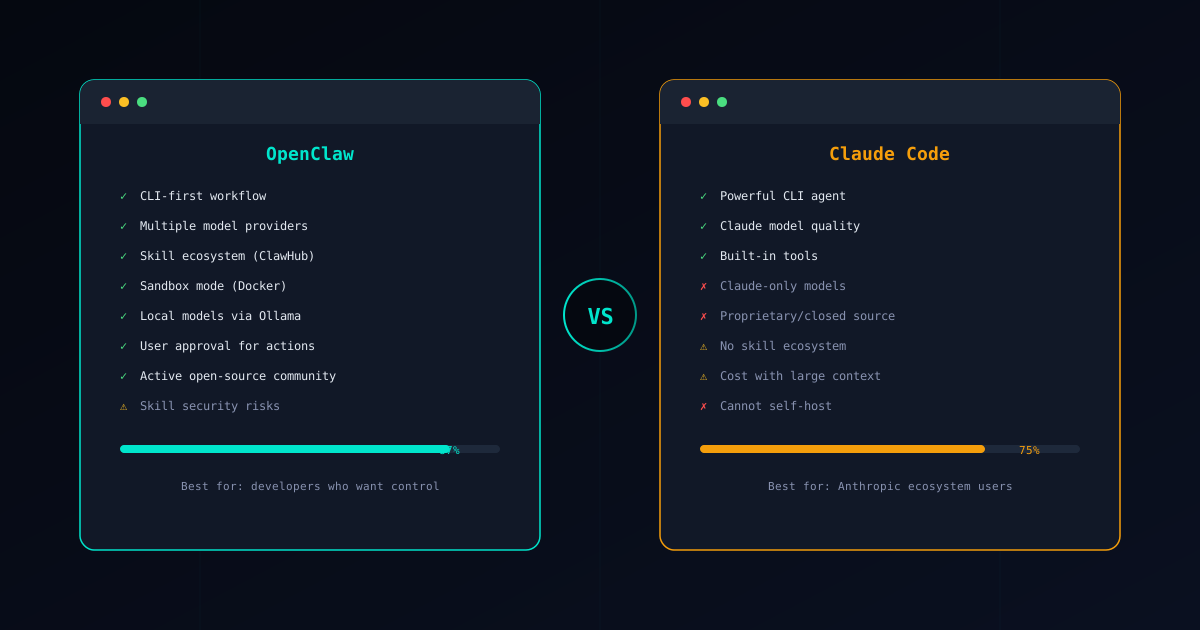
OpenClaw and Claude Code are the two most prominent CLI-based coding agents available today. On the surface, they look similar: both run in your terminal, both help you write and edit code through natural language, and both operate directly on your filesystem. But beneath that surface, they represent fundamentally different philosophies about how a coding agent should work.
Claude Code is built by Anthropic to showcase what their Claude models can do. OpenClaw is built by the open-source community to give developers maximum flexibility and control. This guide compares the two honestly so you can decide which fits your workflow.
If you are new to OpenClaw, start with our What is OpenClaw? overview first.
Core Philosophy
OpenClaw: “Your tools, your models, your rules”
OpenClaw is designed around the principle that a coding agent should adapt to the developer, not the other way around. You choose your model provider through the Gateway system — Claude, GPT-4, Gemini, Llama, or any other LLM. You extend the agent’s capabilities by installing skills from ClawHub. You control exactly what the agent can access through explicit permission grants.
The architecture is modular by design. Skills are discrete, composable units of functionality that have been tested and verified independently. When you need the agent to do something new, you install a skill rather than waiting for a vendor to ship a feature update.
Claude Code: “Best-in-class model, integrated experience”
Claude Code is Anthropic’s vision of what a coding agent looks like when it is tightly coupled to a single, powerful model. The tool is optimized for Claude’s strengths — long context windows, strong code comprehension, and careful reasoning. Everything is built in: file editing, search, command execution, and code analysis.
The trade-off is intentional. By controlling both the model and the tooling, Anthropic can optimize the entire stack. The result is a polished experience that works well out of the box, as long as you are comfortable working exclusively within the Anthropic ecosystem.
Feature Comparison
Here is how the two agents compare across the dimensions that matter most for daily development work:
| Feature | OpenClaw | Claude Code |
|---|---|---|
| Open Source | Yes, fully open | No, proprietary |
| Model Support | Any model via Gateway | Claude models only |
| Extension System | 50+ skills on ClawHub | Built-in tools only |
| Security Model | Docker sandbox + permissions | Permission prompts |
| Cost | $0.10-2.00/task (pay per token) | Pay per token (Claude pricing) |
| Local Models | Yes, via Ollama | No |
| Community | Open-source contributors | Anthropic-managed |
| Customization | Skills, configs, forks | Limited configuration |
The model lock-in deserves emphasis. With Claude Code, every token you send goes through Anthropic’s API. With OpenClaw, you can route tasks to whichever model handles them best — use a fast, cheap model for simple edits and a powerful model for complex reasoning. That flexibility translates directly into cost savings and better results across diverse tasks.
Claude Code’s Limitations
Claude Code is a capable tool built by a talented team. But its design choices create real constraints that matter in practice.
Vendor Lock-In
Claude Code works exclusively with Anthropic’s Claude models. If a competing model becomes better at a specific task — say, Gemini excels at a particular language or GPT-5 handles your domain better — you cannot use it. You are locked into one provider’s pricing, rate limits, availability, and model quality decisions.
This is not hypothetical. The LLM landscape changes rapidly. Models that lead benchmarks in one quarter may fall behind the next. OpenClaw’s Gateway architecture ensures you are never stuck. You can switch providers in a configuration file, or even route different tasks to different models based on cost and capability.
No Skill Ecosystem
Claude Code ships with a fixed set of built-in tools: file editing, search, shell commands, and a few others. If you need functionality that Anthropic has not built, you wait for them to add it or work around the limitation.
OpenClaw’s skill-based architecture means the community can extend the agent’s capabilities independently. Need a skill for database migrations, infrastructure provisioning, or API testing? Check the Verified Skills catalog. If it does not exist yet, you can build and publish it yourself. The ecosystem grows with the community, not with one company’s product roadmap.
Proprietary Black Box
You cannot read Claude Code’s source code. You cannot audit how it handles your files, what data it sends to Anthropic’s servers, or how its permission system is implemented internally. For teams working on sensitive codebases — financial services, healthcare, government contracts — this opacity is a non-starter.
OpenClaw is fully open-source. Every line of code is on GitHub. You can audit the permission enforcement, verify the sandboxing implementation, and fork the entire project if your compliance requirements demand it. Transparency is not a feature; it is the foundation.
Cost Unpredictability with Large Context
Claude Code’s strength — long context windows — is also a cost risk. Complex tasks that require the agent to read many files can consume large amounts of context, and you pay for every token. Without control over which model handles which task, you cannot optimize your spend.
OpenClaw lets you match the model to the task. A simple file rename does not need a frontier model. A complex refactor does. The Gateway system gives you that control, and the skill-based architecture keeps each operation bounded and predictable.
When Claude Code Makes Sense
Claude Code is a good choice in specific situations:
- Teams already committed to Anthropic — If your organization has an Anthropic enterprise contract and has standardized on Claude, adding Claude Code to the workflow is natural and frictionless.
- When Claude model quality is the top priority — Claude is genuinely excellent at code reasoning and generation. If you have tested multiple models and Claude consistently gives you the best results for your specific tasks, and you do not need multi-model flexibility, Claude Code provides the most optimized experience for that model.
- Quick setup without provider configuration — Claude Code works immediately with an Anthropic API key. There is no Gateway to configure, no model routing to set up, and no skill installation. For developers who want to start immediately and worry about flexibility later, the simplicity is valuable.
- Solo developers with straightforward needs — If your workflow is primarily “edit this file, run this command, explain this code,” and you do not need custom skills or sandbox isolation, Claude Code handles these basics well.
Other Alternatives
Claude Code is not the only alternative to OpenClaw in the CLI coding agent space. Several other tools take different approaches:
Aider is an open-source CLI tool focused specifically on pair programming with LLMs. It supports multiple models and integrates tightly with git. Aider is excellent for code editing but lacks the broader skill ecosystem and sandboxing that OpenClaw provides.
Cursor is an AI-powered IDE rather than a CLI tool. If you prefer a graphical editor with AI built in, Cursor is worth evaluating, though it trades the composability and scriptability of CLI agents for a more visual workflow.
For a broader overview of the landscape, see our Best AI Coding Agents 2026 guide.
Security Comparison
Security is where the architectural differences between these two agents matter most.
OpenClaw’s Security Model
OpenClaw provides defense-in-depth with multiple independent layers:
- Skill verification — Every skill in the Verified Skills catalog has been audited for malicious behavior. The Skill Verifier lets you check any skill before installation.
- Sandbox mode — Skills execute inside Docker-based isolation that prevents unauthorized filesystem access, network exfiltration, and system-level commands. See the Sandbox Setup Guide for configuration details.
- Permission model — Each skill declares what it needs (fileRead, fileWrite, network, shell), and you approve or deny those permissions explicitly. A skill that claims to format code but requests network access is immediately suspicious.
- Human approval gates — The agent proposes changes and waits for your confirmation before executing. No surprise modifications, no unauthorized commands.
For a deep dive into securing your setup, read our OpenClaw Security Guide.
Claude Code’s Security Model
Claude Code includes permission prompts that ask before performing file writes and shell commands. This is a reasonable baseline, but it differs from OpenClaw’s approach in important ways:
- No sandboxing — Claude Code runs with the same system access as your terminal session. There is no Docker isolation layer between the agent and your filesystem.
- No skill verification — Since there is no skill ecosystem, there is no verification system. The built-in tools are maintained by Anthropic, which provides a degree of trust but no independent audit path.
- Proprietary enforcement — You cannot verify how the permission system works internally. You trust Anthropic’s implementation because you cannot inspect it.
- No granular permission declarations — Permissions are binary (allow/deny per action type) rather than scoped to specific skills with specific capability requirements.
Claude Code’s security is reasonable for individual developers working on non-sensitive projects. For teams that need auditable, layered, independently verifiable security controls, OpenClaw’s model is substantially more robust.
Conclusion
The choice between OpenClaw and Claude Code comes down to what you value most:
Choose OpenClaw when you need:
- Freedom to use any model from any provider
- An extensible skill ecosystem you can contribute to
- Transparent, auditable, open-source code
- Docker sandboxing and granular permission controls
- Local model support via Ollama for air-gapped or privacy-sensitive work
- A tool that grows with the community, not one company’s roadmap
Choose Claude Code when you want:
- A polished experience optimized for Claude models
- Minimal setup with no provider configuration
- Anthropic’s direct support and maintenance
- Tight integration with the Claude model family
For developers who want control over their tools, their models, and their security posture, OpenClaw is the clear choice. It does everything Claude Code does — including using Claude models — while giving you the freedom to adapt, extend, and audit every layer of the stack.
Ready to get started? Follow the Installation Guide to set up OpenClaw in about 30 minutes. If security is your top concern, begin with the Sandbox Setup Guide and the OpenClaw Security Guide to harden your environment from day one.