OpenClaw vs Devin: Open-Source Agent vs $500/mo AI Developer
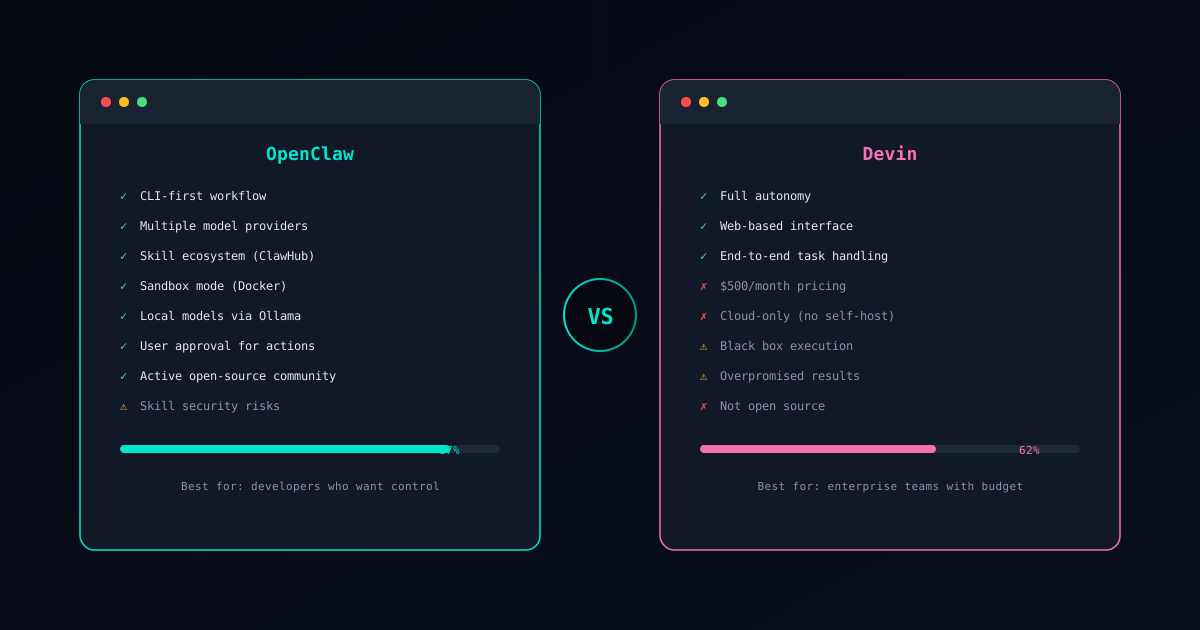
OpenClaw and Devin occupy opposite ends of the AI coding agent spectrum. Devin, built by Cognition Labs, markets itself as the first AI software engineer — a fully autonomous agent that takes a task description and delivers working code without human involvement. OpenClaw is an open-source, human-in-the-loop agent that keeps you in control while leveraging AI to accelerate your work.
The differences run deeper than workflow preferences. They affect your budget, your security posture, the transparency of your toolchain, and whether you actually trust the code that gets produced. This guide compares the two honestly so you can make an informed choice.
If you are new to OpenClaw, start with our What is OpenClaw? overview first.
Core Philosophy
OpenClaw: “AI assists, you decide”
OpenClaw treats AI as a powerful collaborator, not a replacement. The agent proposes changes, you review and approve them, and execution happens only after your explicit confirmation. This human-in-the-loop design is not a limitation — it is a feature that catches mistakes before they reach your codebase.
The skill-based architecture means OpenClaw’s capabilities grow with the community. Install skills from ClawHub for specific tasks, configure your preferred model via Gateway, and run everything on your own infrastructure. You see every step, control every permission, and own every piece of the stack.
Devin: “Hand it off, check back later”
Devin’s pitch is full autonomy. You describe a task — “fix this bug,” “implement this feature,” “set up this infrastructure” — and Devin works independently to deliver the result. It plans, writes code, runs tests, debugs failures, and iterates without asking for human input.
The appeal is obvious: free yourself from the details and let the AI handle implementation. The reality is more complicated. Fully autonomous execution means fully autonomous mistakes, and when an AI agent makes a wrong turn at step three of a twenty-step plan, everything that follows compounds the error. You discover the problem at the end, not when it is cheap to fix.
Feature Comparison
Here is how the two agents compare across the dimensions that matter for real development work:
| Feature | OpenClaw | Devin |
|---|---|---|
| Pricing | $0.10-2.00/task (pay per token) | $500/month flat |
| Autonomy | Semi-autonomous with approval gates | Fully autonomous |
| Open Source | Yes, fully open | No, proprietary |
| Transparency | Full visibility into every step | Black box execution |
| Security | Docker sandbox + permissions + verification | Cloud-based, opaque |
| Human Control | Approval gates at every step | Minimal intervention |
| Self-Hosted | Yes, runs on your machine | No, cloud only |
| Task Reliability | Predictable, skill-bounded | Variable, hard to debug |
The pricing difference alone changes the calculus for most developers. At $500 per month, Devin costs $6,000 per year regardless of how much you use it. OpenClaw’s pay-per-token model means you pay for what you use. A developer running 10-20 tasks per day with OpenClaw typically spends $30-60 per month — roughly one-tenth of Devin’s cost.
Devin’s Fundamental Problems
Devin’s launch generated enormous hype. The demo videos were impressive. But as real users have worked with the product over the past year, four core problems have become clear.
The $500/Month Problem
Devin’s flat monthly pricing puts it out of reach for individual developers, students, open-source contributors, and small teams. At $6,000 per year, it is more expensive than most developer tools combined. You are paying that rate whether you use Devin for 100 tasks or 10.
OpenClaw’s token-based pricing means your cost scales with your usage. A light week costs a few dollars. A heavy week of complex refactoring might cost $20-30. You never pay for capacity you are not using, and you can control costs by choosing which model handles which task through the Gateway system.
The Black Box Problem
When Devin works on your task, you cannot see exactly what it is doing in real time. You submit a request and receive a result. If the result is wrong, diagnosing why is difficult because you do not have visibility into the agent’s reasoning, the intermediate steps it took, or the decisions it made along the way.
This opacity makes debugging AI-generated code harder, not easier. When OpenClaw proposes a change, you see the reasoning, review the diff, and approve or reject it. When something goes wrong, you know exactly where the process diverged from your intent because you were present for every decision.
The Cloud-Only Problem
Devin runs on Cognition Labs’ cloud infrastructure. Your code, your prompts, your project context — all of it leaves your machine and is processed on someone else’s servers. For many teams, especially those working on proprietary software, regulated industries, or security-sensitive projects, this is an unacceptable risk.
OpenClaw runs on your machine. Your code never leaves your infrastructure unless you explicitly choose to use a cloud-hosted LLM, and even then, only the relevant context is sent — not your entire codebase. For fully air-gapped operation, you can run OpenClaw with local models via Ollama. Your code, your servers, your control.
The Autonomy Gap
Devin’s marketing promises a fully autonomous AI developer. The reality is that complex, real-world development tasks require judgment calls that current AI systems handle inconsistently. Devin can produce impressive results on well-defined, isolated tasks. But when tasks involve ambiguous requirements, trade-off decisions, or integration with existing systems, the autonomous approach frequently produces code that technically works but misses the intent.
The fundamental issue is that “fully autonomous” and “reliably correct” are in tension with current AI capabilities. OpenClaw acknowledges this honestly. The human-in-the-loop design is not a compromise — it is the most reliable path to correct results given where AI technology actually is today.
When Devin Makes Sense
Devin has legitimate use cases, and dismissing it entirely would be dishonest:
- Enterprise teams with budget — Large engineering organizations that spend $6,000/year on a developer tool without blinking may find Devin’s autonomous workflow saves senior engineer time on routine tasks.
- Well-defined, isolated tasks — When the task is clear, the scope is bounded, and the codebase is relatively simple, Devin’s fully autonomous approach can deliver results efficiently.
- “Hand it off and check back” workflows — Some tasks genuinely benefit from asynchronous delegation. If you have a backlog of straightforward implementation tasks and you want to batch-process them overnight, Devin’s model fits that use case.
- Teams evaluating autonomous agents — If your organization is exploring what fully autonomous AI development looks like, Devin is the most polished product in that category and provides a realistic view of the current state of the art.
The common thread: Devin works best when the task is simple enough that full autonomy does not introduce risk, and when the cost is not a constraint.
Other Alternatives
Devin is not the only alternative to OpenClaw for AI-assisted development. Several other frameworks take different approaches:
CrewAI uses a multi-agent architecture where specialized AI agents collaborate on tasks. It is more structured than fully autonomous agents but still operates without human approval gates. CrewAI is open-source but requires significant configuration to be production-ready.
AutoGPT is the original autonomous AI agent framework. It is open-source and free but suffers from planning loops, token waste, and reliability issues. AutoGPT is better suited for experimentation than production work.
SWE-Agent from Princeton focuses specifically on software engineering tasks with a research-oriented approach. It shows strong results on benchmarks but is more of a research tool than a daily-use product.
For a broader overview of the landscape, see our OpenClaw Alternatives guide.
Security Comparison
Security is where the difference between self-hosted, open-source tools and cloud-based proprietary services becomes stark.
OpenClaw’s Security Model
OpenClaw provides multiple independent layers of protection:
- Skill verification — Every skill in the Verified Skills catalog has been audited for malicious behavior. The Skill Verifier lets you check any skill before installation.
- Sandbox mode — Skills execute inside Docker-based isolation that prevents unauthorized filesystem access, network exfiltration, and system-level commands. See the Sandbox Setup Guide for configuration details.
- Permission model — Each skill declares what it needs (fileRead, fileWrite, network, shell), and you approve or deny those permissions explicitly. A skill requesting capabilities beyond its stated purpose is immediately flagged.
- Human approval gates — Every change is proposed and reviewed before execution. No autonomous modifications to your codebase.
- Self-hosted by default — Your code stays on your machine. Nothing leaves your infrastructure without your explicit decision.
For a deep dive into securing your setup, read our OpenClaw Security Guide.
Devin’s Security Model
Devin’s security model is largely invisible to the user:
- Cloud processing — Your code is sent to Cognition Labs’ infrastructure for processing. You trust their security practices because you cannot independently verify them.
- No self-hosting — There is no option to run Devin on your own servers. Your code, context, and prompts are processed externally.
- Opaque data handling — How your code is stored, how long it is retained, and who can access it on Cognition’s side is governed by their privacy policy, not by controls you manage.
- No sandboxing transparency — Devin may use sandboxing internally, but you cannot verify the implementation or customize it for your security requirements.
- No permission granularity — Since Devin operates autonomously, there is no step-by-step permission approval. You grant broad access when you submit a task.
For teams handling sensitive code, regulated data, or proprietary algorithms, Devin’s cloud-only, opaque security model presents significant risk. OpenClaw’s transparent, self-hosted, auditable approach gives you the evidence your compliance team needs.
Conclusion
The choice between OpenClaw and Devin reflects a deeper question about how you want to work with AI:
Choose OpenClaw when you need:
- Affordable, pay-per-use pricing that scales with your actual usage
- Full visibility into what the AI is doing and why
- Self-hosted operation that keeps your code on your infrastructure
- Docker sandboxing, permission controls, and verified skills
- Multi-model flexibility to use the best LLM for each task
- An open-source tool you can audit, fork, and contribute to
Choose Devin when you want:
- Fully autonomous task execution with minimal supervision
- Enterprise-backed service with dedicated support
- Asynchronous “submit and check back” workflow
- A polished product for teams where the $500/month cost is immaterial
For the vast majority of developers and teams, OpenClaw delivers better results at a fraction of the cost, with security and transparency that Devin cannot match. The human-in-the-loop approach is not a limitation — it is the reason OpenClaw’s output is reliable enough to trust in production.
Ready to get started? Follow the Installation Guide to set up OpenClaw in about 30 minutes. If security is your top concern, begin with the Sandbox Setup Guide and the OpenClaw Security Guide to harden your environment from day one.