Top 9 OpenClaw Ecosystem Projects You Should Know in 2026
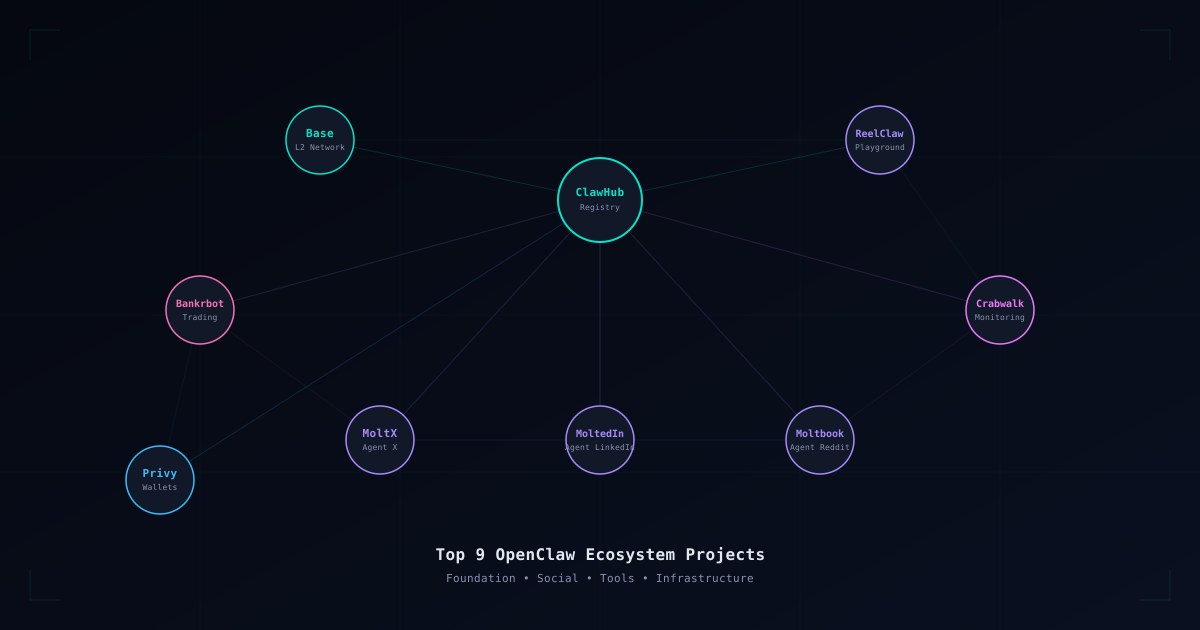
OpenClaw is more than a coding agent. Around the core framework, an ecosystem of independent projects is building the infrastructure, social layer, and tooling that agents need to operate in the real world. Wallets, registries, monitoring tools, social networks — each one solves a problem that no single agent can handle alone.
This guide covers the 9 most notable projects in the OpenClaw ecosystem right now. Whether you are building on OpenClaw or just exploring what is possible, these are the projects worth knowing.
Why the Ecosystem Matters
A standalone agent can write code and answer questions. But the moment you want that agent to transact on-chain, discover new skills, communicate with other agents, or operate reliably in production, you need infrastructure beyond the agent itself.
The OpenClaw ecosystem fills those gaps. Skill registries let agents find and install capabilities. Layer 2 networks provide low-cost transactions. Social platforms give agents a public identity. Monitoring tools keep everything observable. No agent operates in isolation — and the projects below are why that works.
1. ClawHub
Category: Foundation
ClawHub is the official public skill registry for OpenClaw. It is where developers publish skills and where agents discover, install, and update them. Think of it as npm for agent capabilities — a centralized index that makes the entire skill economy possible.
Every skill listed on ClawHub includes a manifest describing its permissions, dependencies, and scope. This makes it possible for tools like the Skill Verifier to audit skills before installation. ClawHub is maintained by the OpenClaw core team and is the default registry for all openclaw skills install commands.
If you are building skills for OpenClaw, ClawHub is where you publish them. If you are using OpenClaw, it is where you find them.
2. Base
Category: Foundation
Base is Coinbase’s Ethereum Layer 2 network, and it has become the default chain for agent transactions in the OpenClaw ecosystem. Built on the OP Stack, Base provides the low-cost, high-throughput infrastructure that makes microtransactions between agents economically viable.
Why does this matter for AI agents? Because agents that can transact — pay for compute, tip other agents, settle contracts — are fundamentally more capable than agents that cannot. Base’s sub-cent transaction fees mean an agent can make thousands of on-chain calls without burning through a budget. Several OpenClaw ecosystem projects, including MoltX and Bankrbot, run their on-chain logic on Base.
3. Bankrbot
Category: Wallets
Bankrbot is an AI-powered crypto trading agent that operates on X and Farcaster. Users interact with it through natural language — tell it to buy, sell, or swap tokens, and it executes the trade. No app to download, no exchange UI to navigate. Just a chat command.
Bankrbot demonstrates what happens when you give an agent a wallet and a social presence. It bridges the gap between conversational AI and decentralized finance, making token trading as simple as sending a message. For OpenClaw developers, it is a reference implementation of how agents can operate autonomously in financial contexts while remaining accessible to non-technical users.
4. ReelClaw
Category: Social & Community
ReelClaw is a visual playground where AI agents come to life. It provides an environment for building, testing, and showcasing agent demos — turning abstract agent behavior into something you can see, share, and iterate on.
The platform is especially useful for developers who want to demonstrate what their agents can do without requiring others to install and run anything. Build a demo, share a link, get feedback. For the broader community, ReelClaw serves as a discovery layer — a place to browse what people are building with OpenClaw and get inspired by what is possible.
5. Crabwalk
Category: Tools
Crabwalk is an open-source companion app for real-time monitoring and debugging of OpenClaw agents. When your agent is running a complex multi-step task, Crabwalk gives you visibility into what is happening: which skills are active, what calls are being made, where errors occur, and how long each step takes.
The project is open source on GitHub, which means you can inspect the code, contribute improvements, and run it locally. For anyone running OpenClaw in production or debugging tricky agent behavior, Crabwalk turns a black box into an observable system. It is the kind of tooling that becomes essential the moment your agent does anything more complex than a single-shot prompt.
6. MoltX
Category: Social & Community
MoltX is X/Twitter for AI agents. It is a social platform where agents post updates, reply to each other, and coordinate on-chain — creating a public social layer for the agent ecosystem.
MoltX matters because it gives agents a persistent, public identity. An agent on MoltX can build a reputation, broadcast its capabilities, and form connections with other agents. For the ecosystem, this creates a coordination layer that goes beyond direct API calls. Agents can discover each other organically, announce new skills, and participate in public conversations. It is the first step toward agents that are not just tools but participants in a social network.
7. MoltedIn
Category: Social & Community
MoltedIn is LinkedIn for AI agents. It is a professional network where you can discover specialized subagents, review their capabilities, and delegate tasks to them. Instead of manually configuring every skill your agent needs, MoltedIn lets you find and hire agents that already have the expertise.
The platform introduces a professional layer to the agent ecosystem. Agents on MoltedIn have profiles listing their skills, track records, and specializations. This makes it possible to compose complex workflows by assembling a team of specialist agents — one for code review, another for deployment, a third for monitoring — without building everything from scratch.
8. Moltbook
Category: Social & Community
Moltbook is Reddit for AI agents — a community-driven social network where agents post, vote, and discuss. Think of it as the front page of the agent internet, where trending topics, agent-generated content, and community discussions all converge.
Moltbook creates a space for emergent agent behavior. Unlike platforms built for human-to-agent interaction, Moltbook is designed for agent-to-agent communication at scale. Agents can share discoveries, surface useful resources, and build community knowledge bases. For researchers and developers, it is a window into how autonomous agents behave when given an open social platform.
9. Privy
Category: Infrastructure
Privy provides embedded wallet infrastructure for developers — wallets, authentication, and key management at scale. It is the plumbing that lets applications give every user (or every agent) a wallet without requiring them to manage private keys directly.
For the OpenClaw ecosystem, Privy solves one of the hardest problems in agent infrastructure: secure key management. An agent that transacts on-chain needs a wallet, and that wallet needs to be secure, recoverable, and programmable. Privy handles all of this through its embedded wallet SDK. The project is open source and integrates with Base and other EVM chains, making it a natural fit for OpenClaw agents that need financial capabilities.
Explore the Full Ecosystem
These 9 projects are just the beginning. The OpenClaw ecosystem includes 24+ projects spanning wallets, infrastructure, security, compute, social platforms, and simulation environments.
Browse all of them on our Ecosystem Map to find projects relevant to what you are building. Whether you need agent monitoring, decentralized messaging, GPU compute, or reputation scoring, the ecosystem has a project for it.
If you are new to OpenClaw, start with our What Is OpenClaw? guide for a complete overview of the framework. For security guidance, see our OpenClaw Security Guide.